
KKR publica regularmente Investor Servicing Decks que sintetizan sus estrategias institucionales para los Limited Partners (LPs) — pension funds, sovereign wealth funds, family offices grandes, endowments universidades. Estos materiales son educativos sobre las tesis investment de KKR y aportan contexto sobre por qué consideran ciertos sectors structural growth.
Para BISSAN, este KKR Infrastructure deck es relevante por tres razones. Primera, es el seguimiento natural a su paper "Beyond the Bubble" sobre AI infrastructure que comentamos hace dos semanas — aquí KKR articula el broader infrastructure thesis del cual data centers son solo una piece. Segunda, $106 trillones de capex global hasta 2040 es número monumental que recalibra la magnitud del theme. Tercera, KKR es uno de los mayores players globales en private infrastructure — entender su perspective ayuda a evaluar la calidad del flow de deals disponibles.
1. El número que importa: $106 trillones hasta 2040
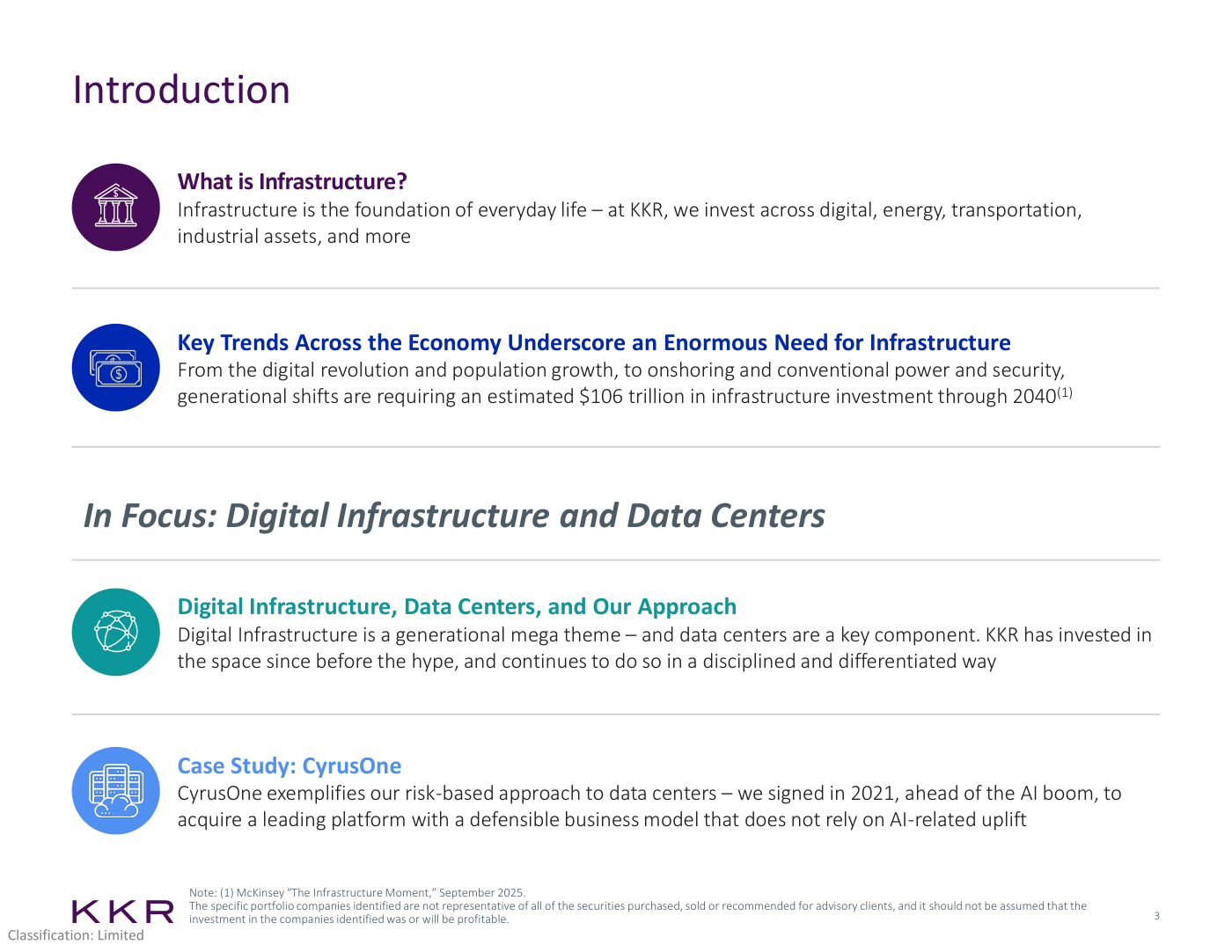
McKinsey estima en su Infrastructure Moment (Sep 2025) que el global capex needed para infrastructure es $106 trillones acumulados hasta 2040 — aproximadamente $7 trillones por año. Para context: el GDP global es aproximadamente $105 trillones. Es decir, infrastructure spending will be approximately 7% of global GDP annual durante 15+ años — una de las thematic spending booms más grandes de la historia económica documentada.
La distribución por sector:
- Transportation: roads, bridges, airports, ports, railroads. Probably $25-30T del total.
- Energy (conventional + renewables + grid + storage): $35-40T.
- Digital (data centers, fiber, towers, network equipment): $15-20T.
- Water & sanitation: $5-7T.
- Social infrastructure (hospitals, schools, housing): $20-25T.
- Industrial (factories, logistics, supply chain): $10-15T.
Para BISSAN, esta thematic spending magnitude justifica overweight estructural a infrastructure-related sectors en carteras diversificadas. Esto incluye: utilities (especialmente regulated + renewable), industrial REITs (logistics, data centers), pipeline operators (energy transport), engineering & construction firms (Vinci, ACS, Skanska), y telecommunications infrastructure (cell towers, fiber).
2. Las ocho megatrends de KKR
KKR organiza la infrastructure thesis en 8 megatrends interconectadas.
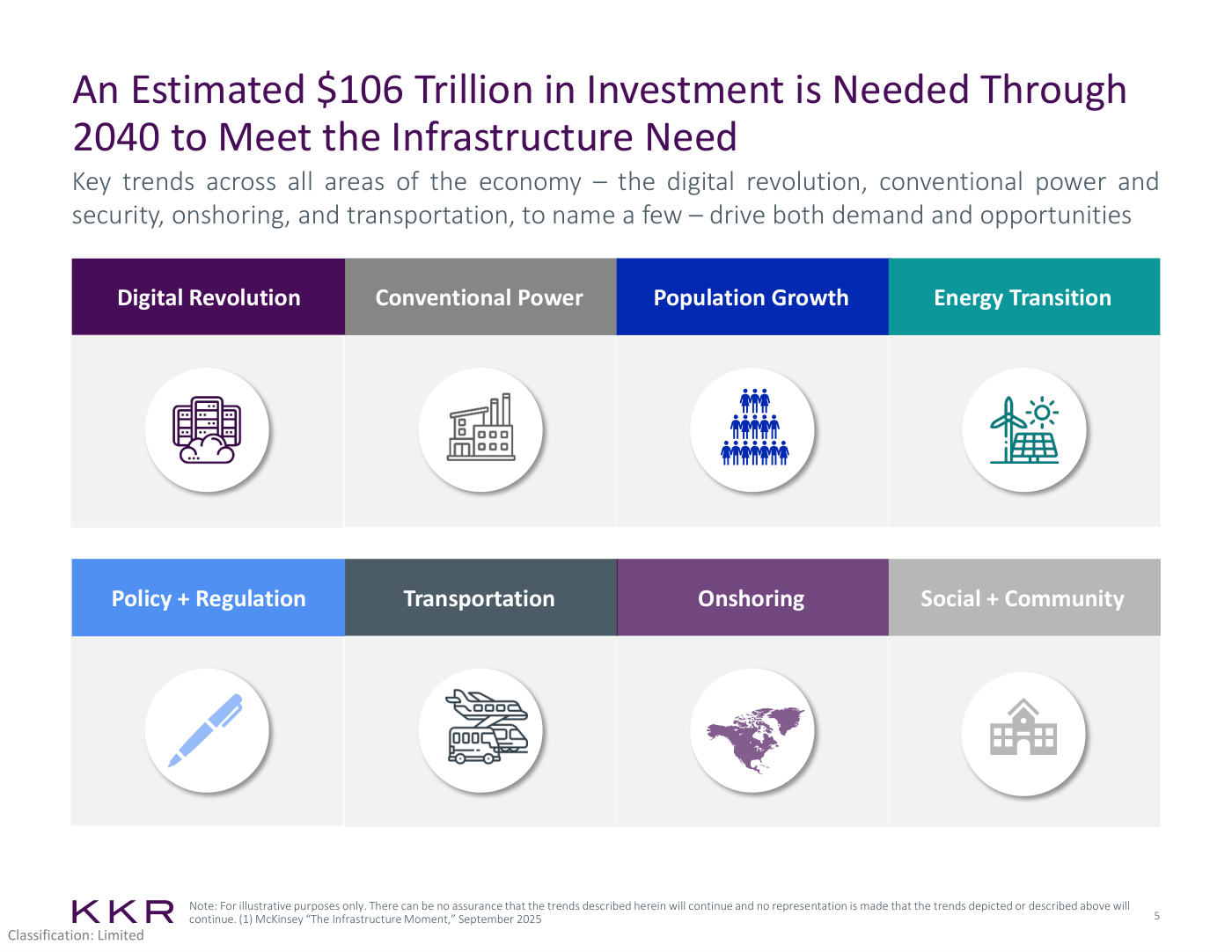
Las 8 megatrends y sus implicaciones operativas:
Digital Revolution: data centers, fiber networks, cell towers, edge computing. Drivers: AI training/inference, streaming video, e-commerce, IoT. Capex anual estimado $1-2T globalmente.
Conventional Power: gas-fired power generation, nuclear (revival), pipeline infrastructure. Sigue siendo necesario porque renewables intermitentes requieren baseload + peaking generation. Capex anual $500-700B.
Population Growth: housing, water, hospitals, schools en growing geographies (Africa, India, Southeast Asia). Capex anual $1-1.5T.
Energy Transition: solar, wind, storage, hydrogen, grid modernization. Capex anual $1.5-2T — la categoría más grande structurally.
Policy + Regulation: government infrastructure spending programs (Inflation Reduction Act USA, Green Deal EU, Belt & Road China continuation). Catalyst de los otros trends.
Transportation: high-speed rail, EV charging infrastructure, airport modernization, port automation. Capex anual $1-1.5T.
Onshoring: factories nuevas en USA, Mexico, Europe (post-China decoupling). Drives industrial real estate, power infrastructure. Capex anual $500-800B incremental.
Social + Community: healthcare facilities, schools, affordable housing. Más fragmentado pero combined es $1-1.5T anual.
Para BISSAN, exposure indirect a estos trends viene via diversificación across sectors: utilities (energy trans), industrials (transportation + onshoring), telecom (digital), materials (raw materials para infrastructure build-out), real estate especialista (data centers + logistics + healthcare). Una cartera diversificada captures gran parte de estos trends naturalmente — no requiere position táctica específica.
3. Digital infrastructure: el subsector que KKR enfatiza
KKR dedicates la mayor parte del deck a digital infrastructure — y es el subsector más directamente relevante para BISSAN clients hoy dada la AI narrative en mercados públicos.
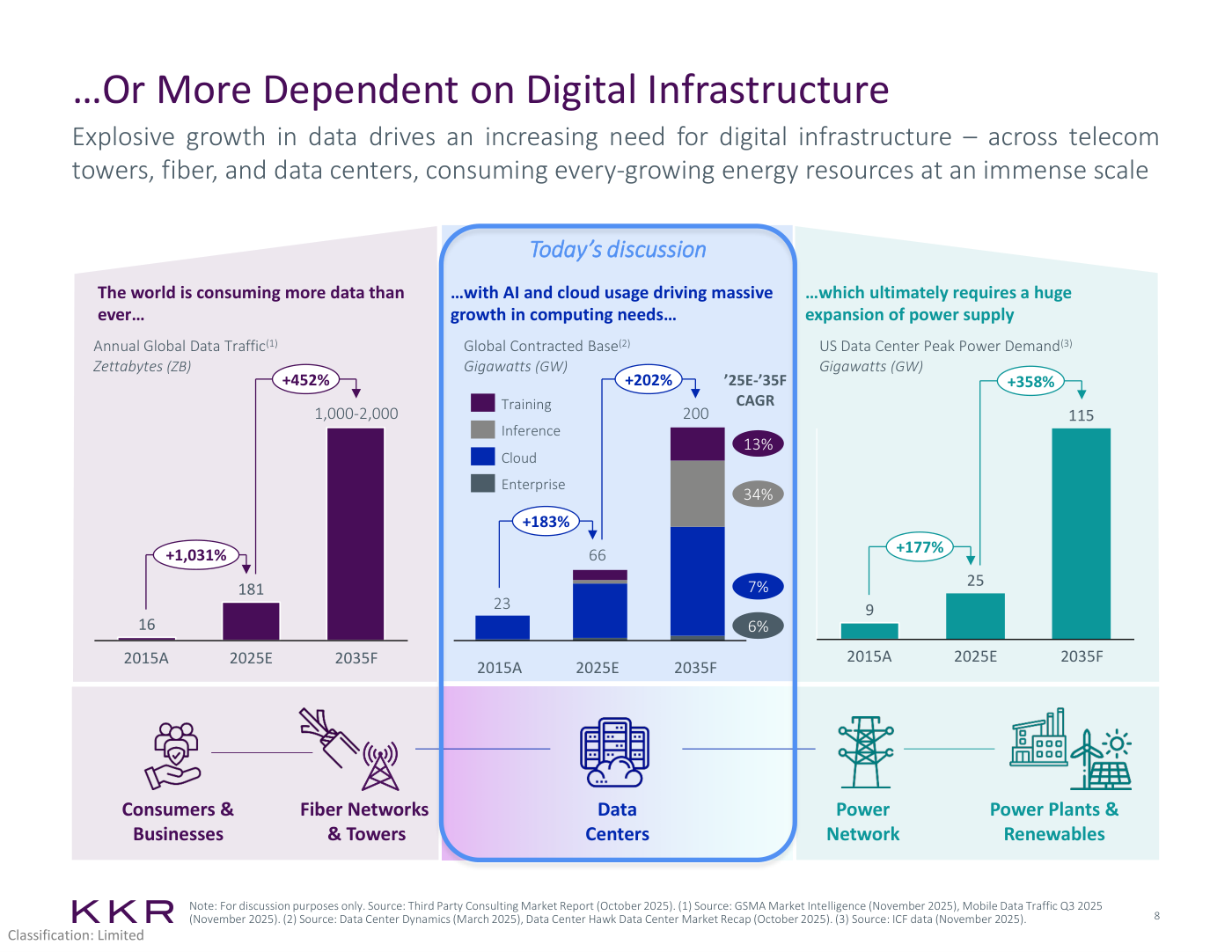
Los datos son contundentes. El consumo de datos globales ha crecido +1.031% entre 2015 y 2025 (de 16 a 181 ZB, con proyección 1.000-2.000 ZB en 2035). La Global Contracted Base de cómputo sube de 23 GW (2015A) a 66 GW (2025E) y 200 GW (2035F). US data center peak power demand pasa de 9 GW (2015A) a 25 GW (2025E) y 115 GW (2035F) — una de las thematic infrastructure growth stories más material de las últimas décadas.
Lo que esto significa operativamente: la demand para power generation, grid capacity, transformers, cooling equipment, real estate especializada (data center sites con power + fiber + water), y skilled construction labor está expandiéndose dramatically. Los players posicionados ahora (KKR + Brookfield + Stonepeak + DigitalBridge + Macquarie + Blackstone Infrastructure) están capturing el flow de capital que servirá demanda durante los próximos 15+ años.
4. CyrusOne: el case study flagship de KKR
KKR detalla su data center platform portfolio con 6 plataformas:
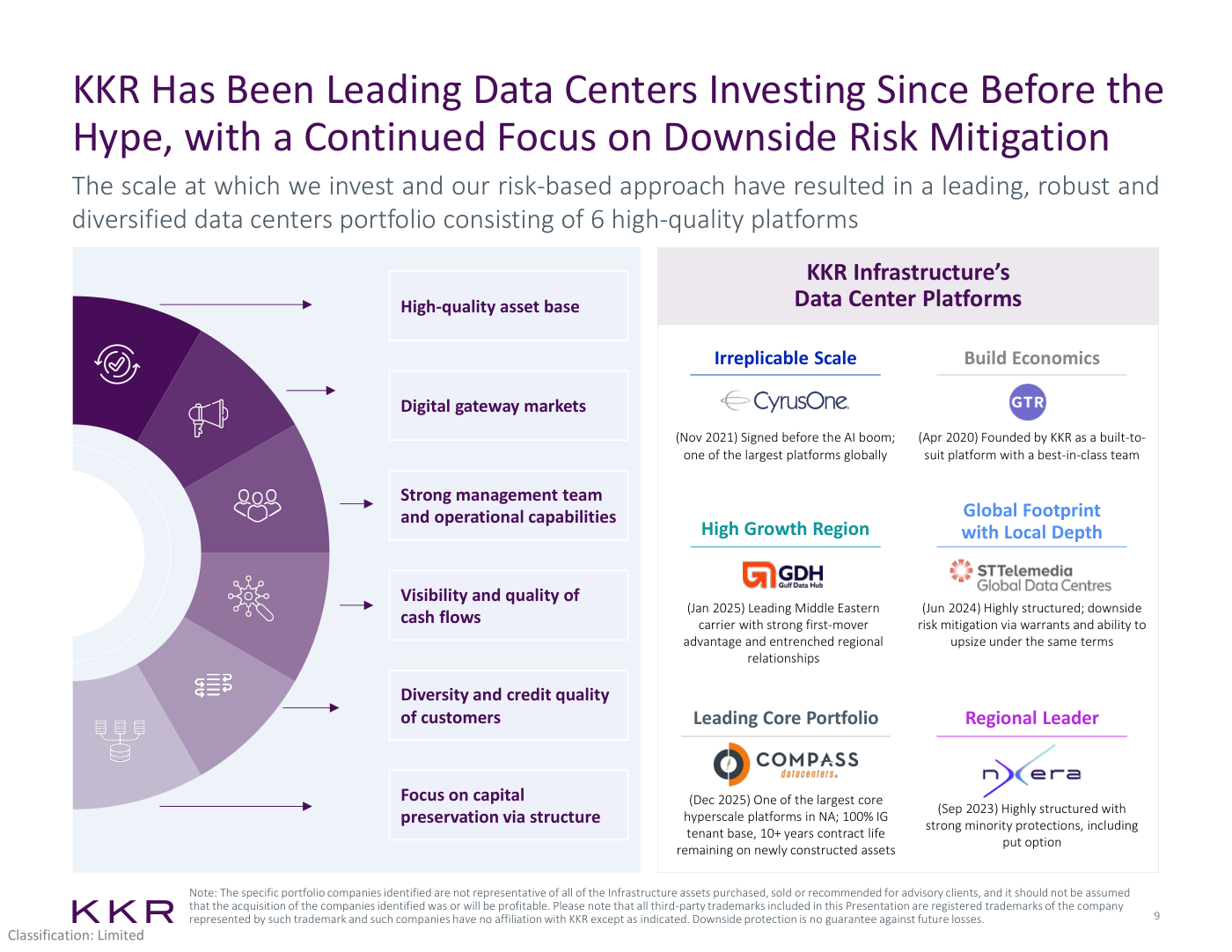
CyrusOne es la flagship platform. KKR adquirió CyrusOne en 2021 (antes de ChatGPT, antes del AI hype). En 2021, CyrusOne era ya leading data center platform fundada en 2004. El timing — antes del rally AI — es importante para KKR porque demuestra disciplined approach: no chasing AI hype, sino positioning ahead de structural demand. KKR claims que el thesis investment funciona incluso sin "AI-related uplift" — i.e., even bajo escenarios pesimistas donde AI demand decepciona, CyrusOne sigue siendo viable platform.
Scale de CyrusOne (p.10, no agregado de las 6 plataformas):
- 60+ data centers in operation
- 20+ markets globales (USA, EMEA — Dublín, Londres, Ámsterdam, Fráncfort, Milán, Madrid, París — y Japón/Osaka)
- 20+ años de development track record
- ~1 GW in-service capacity
- ~1.6 GW contracted capacity
Para context: el global data center market es approximately 30-50 GW operating capacity total. El ~1 GW in-service de CyrusOne ≈ 2-3% global market share — una de las mayores positions privadas individuales en el sector.
Adicional a CyrusOne: GTR (Apr 2020, built-to-suit), GDH (Jan 2025, carrier líder en Oriente Medio), ST Telemedia Global Data Centres (Jun 2024, footprint global), Compass Datacenters (Dec 2025, core hyperscale Norteamérica) y nXera (Sep 2023, regional leader). La diversificación geográfica + risk profile reduce concentration risk single-platform.
5. Implicaciones para BISSAN
Tres lecturas operativas:
Primera, infrastructure exposure overweight estructural en clases Pólvora y LP. El $106T thematic capex global hasta 2040 justifica overweight a sectors expuestos: utilities, industrials, materials, real estate especialista, telecom infrastructure. En Pólvora target 8-10%, LP target 12-15% en estas categorías combined.
Segunda, private infrastructure consideration para LP. Para clientes BISSAN con ticket size $1M+ y horizonte 10+ años, considerar allocation a private infrastructure funds. KKR Infrastructure Fund es uno de varios — Brookfield Infrastructure Partners (listed equivalent vía BIPC), Stonepeak Infrastructure Fund, DigitalBridge Infrastructure, Macquarie Infrastructure. Target return 10-13% net of fees, low correlation con public markets, illiquidity premium materially benefit largo plazo.
Tercera, exposure indirect via listed REITs y equity. Para clientes sin ticket size suficiente para private funds: data center REITs (Digital Realty DLR, Equinix EQIX), tower REITs (American Tower AMT, Crown Castle CCI), utility ETFs (XLU, JXI). Returns probably 5-8% por dividends + 3-5% capital appreciation = 8-13% total, comparable a private pero con liquidity diaria.
6. Conclusión y caveats
KKR Infrastructure thesis es structurally sound y bien-documentada. $106T global capex hasta 2040 representa un structural growth tailwind que beneficiará multiple sectors y subsectors durante 15+ años. KKR es one of mejor-positioned players para capturar este flow.
Tres caveats importantes:
Primero, sesgo institucional. KKR es selling its own Fund. Mat material es marketing — aunque con calidad de research detrás. No invalida la tesis pero requiere contexto.
Segundo, illiquidity risk. Private infrastructure funds typically 10-12 year lockups, capital calls progresivos, possibility of underperforming public alternatives during specific periods. Solo apropriate para clients con genuinely long horizon.
Tercero, fee structure. Private infrastructure fund fees: 1.5-2.0% management + 20% carry above hurdle. Net of fees, returns puede be 200-300bp lower que gross targets. Important para evaluate vs listed alternatives.
Para BISSAN clase LP con clients sofisticated interested en private infrastructure, podemos facilitar discussions con KKR y/o equivalent providers. Para clase Pólvora, listed REITs y utility ETFs son better fit. Para Blindaje, infrastructure exposure debe ser mínima — illiquidity y volatility no encajan con perfil conservador.
7. Cross-reference con otros papers BISSAN comentados
El KKR Infrastructure deck encaja perfectly con otros temas que hemos developed durante el otoño 2025:
KKR "Beyond the Bubble" (Nov 2025): defendiendo AI infrastructure como structural growth, no bubble. Combined con este Infrastructure deck, KKR articulates a complete digital infrastructure thesis donde data centers son centerpiece de un broader $106T capex global.
Sparkline Capital "Surviving the AI Capex Boom": identifica que las acciones públicas de AI hyperscalers están potentially overvalued, pero la infrastructure física subyacente seguirá demand strong. KKR Infrastructure expone exactly a esa infrastructure física vía private vehicles.
UBS "AI Revisiting Outlook": documenta el +67% YoY de AI capex 2025. KKR Infrastructure es uno de los players capturando ese capital flow vía data center platforms.
Stifel "Biopharma Market Update" + Stifel "Breast Cancer": healthcare infrastructure (hospitals, lab spaces, R&D facilities) es uno de los components del $106T total — KKR menciona Social + Community como pillar pero no desarrolla específicamente healthcare facilities.
La síntesis BISSAN integrada: estamos en thematic structural growth period para infrastructure broadly. Clientes BISSAN con horizonte largo (clase LP) y apetito private equity vintage diversification merecen exposure incremental a este theme via vehículos especializados. Clientes con horizonte medio (Pólvora) capturen el mismo theme via listed alternatives. Clientes conservativos (Blindaje) tienen exposure indirect via utility + telecom holdings standard.
8. Action items para Comité de Inversión BISSAN
Tres items concretos a discutir en próximo Comité:
Item 1: Evaluate adding allocation 3-5% NAV en infrastructure dedicated funds para clase LP. Candidates evaluation: KKR Infrastructure Fund VI (current vintage), Brookfield Infrastructure Partners V, Stonepeak Infrastructure Fund V. Decision criteria: track record, fees, alignment with BISSAN structural thesis.
Item 2: Para clase Pólvora, considerar overweight táctico a infrastructure-related listed equities. Specifically: utility ETF (XLU o JXI) + data center REITs (DLR + EQIX) + tower REITs (AMT + CCI). Target combined allocation: 8-10% del NAV equity. Currently approximately 5-6% — incremental allocation 200-400bp.
Item 3: Para clase Blindaje, ningún cambio inmediato. Mantener utility bond exposure existing (en bonds investment grade portfolio) y revisar al rebalanceo trimestral próximo.
Estos tres items requieren discussion del Comité antes de implementation — no son cambios automáticos pero sí items concretos sobre la mesa.